
Table of Contents
Surgical excision of tattoo is a form of tattoo removal in which a surgeon physically removes the skin containing tattoo pigment. Unlike laser tattoo removal, which breaks tattoo ink into smaller particles that the body can gradually clear, surgical excision removes the tattoo-bearing tissue itself.
For selected tattoos, particularly smaller tattoos with enough surrounding skin for safe closure, excision can be an effective way to remove tattooed skin. However, it is important to understand the trade-off: surgical tattoo removal creates a wound and therefore a permanent scar is expected.
Whether tattoo excision is appropriate depends on much more than tattoo size. A qualified surgeon will consider the tattoo’s location, shape, skin elasticity, available skin, wound tension, previous treatments, expected scar, and overall health before recommending surgery.
What Is Surgical Excision of Tattoo?
Tattoo excision surgery involves removing the portion of skin that contains the tattoo. After the tattooed tissue is removed, the surgeon manages the resulting wound using the most appropriate closure or reconstruction technique.
For a small tattoo, the surgeon may be able to remove the tattooed skin and close the wound directly with sutures. Larger or more complex tattoos may require serial excision, skin grafting, local flap reconstruction, or other surgical techniques.
The objective is not simply to remove the maximum amount of tattooed skin. The surgeon must also consider whether the remaining skin can be closed safely and what type of scar is likely to result.
Does Tattoo Size Determine Whether Excision Is Possible?
Tattoo size is an important factor, but there is no universal size limit for surgical tattoo removal.
Small tattoos are often easier to remove because the resulting wound may be small enough for direct closure. However, a small tattoo located on tight or highly mobile skin can be more challenging than a larger tattoo in an area with greater skin laxity.
Large tattoos may sometimes be treated through staged or serial excision, allowing the surgeon to remove sections over multiple procedures.
The tattoo’s shape, location, skin elasticity, and available surrounding tissue can therefore be just as important as its dimensions.
Does Tattoo Location Affect Surgical Excision?
Yes. Tattoo location can significantly influence the feasibility of surgical excision and the expected scar.
Areas with greater skin laxity may provide more tissue for wound closure, while areas with tight skin can create greater tension after an excision. Tattoos near joints may require additional planning because movement can stress the healing incision.
The hands, feet, lower legs, face, and other cosmetically sensitive areas can also present unique challenges. A tattoo of the same size can have very different surgical options depending on where it is located.
This is why a surgeon evaluates the tattoo and surrounding skin as a complete anatomical area, rather than judging suitability from tattoo size alone.
What Surgical Techniques Can Be Used for Tattoo Excision?
The appropriate tattoo excision technique depends on the tattoo’s characteristics and the resulting surgical defect.
Simple Excision and Primary Closure
The tattooed skin is removed and the surrounding skin is brought together and closed, commonly with sutures. This is generally most suitable for selected smaller tattoos.
Punch Excision
A punch instrument can remove a small circular section of tattooed skin. This approach may be considered for very small tattoos or isolated tattooed areas.
Serial or Staged Excision
Staged tattoo excision involves removing the tattoo in sections over multiple procedures. This can allow surrounding skin to adapt between operations and may make closure more manageable for larger tattoos.
Skin Grafting
If the wound cannot be closed directly, a skin graft may be used to cover the defect. Skin is taken from another part of the body and placed over the surgical wound.
Local Flap Reconstruction
A local flap uses nearby tissue that remains connected to its blood supply and is moved to cover the defect. This may be considered when direct closure is not practical.
Tissue Expansion
In selected complex cases, tissue expansion can gradually increase the amount of available skin before reconstruction.
Healing by Secondary Intention
Some wounds may be allowed to heal naturally without immediate surgical closure. Whether this is appropriate depends heavily on the wound’s size, depth, location, and expected cosmetic result.
Does Surgical Tattoo Removal Hurt?
Tattoo excision is performed using anesthesia to minimize pain during the procedure. Smaller procedures may often be performed using local anesthesia, while the appropriate anesthesia plan for more extensive surgery depends on the procedure and patient.
After the anesthetic wears off, some soreness, tenderness, swelling, or sensitivity may occur. Discomfort can vary according to tattoo size, location, surgical technique, wound size, and individual pain tolerance.
Your surgeon should provide personalized instructions for managing postoperative discomfort.
Will Surgical Excision Leave a Scar?
Yes. A scar is an inherent part of surgical tattoo excision.
Because the procedure removes skin, the resulting wound must heal. Even when healing progresses normally, a surgical scar generally remains.
Scar appearance can be influenced by:
- Tattoo size and shape
- Body location
- Incision design
- Wound tension
- Surgical technique
- Individual healing
- Previous hypertrophic scars or keloids
- Postoperative wound care
A scar may initially be red, firm, raised, or more noticeable and can gradually change as it matures.
This creates an important distinction between tattoo removal and skin restoration. Excision may remove the tattoo-bearing skin, but it does not guarantee that the area will look exactly as it did before the tattoo.
What Is Recovery Like After Tattoo Excision?
Tattoo excision recovery varies according to the size and location of the wound, closure technique, and individual healing.
During the first 24–48 hours, the priority is generally protecting the surgical site and following the surgeon’s wound-care instructions. Some tenderness, swelling, or bruising may occur.
During the first week, the incision continues through the early stages of healing. Follow-up may be required to evaluate the wound and manage sutures if necessary.
Normal activities and exercise may need to be restricted temporarily, particularly if movement, friction, stretching, or heavy lifting could place tension on the incision.
Although the wound may heal relatively quickly, scar maturation takes considerably longer and can continue for many months.
Tattoo Excision Aftercare: What Should You Do?
Good tattoo excision aftercare helps protect the surgical wound while it heals.
Your surgeon may provide instructions regarding:
- Keeping the surgical site clean
- Changing or maintaining dressings
- Taking medications as prescribed
- Protecting the wound from friction
- Avoiding unnecessary tension
- Limiting exercise temporarily
- Protecting the healing scar from excessive sun exposure
- Attending follow-up appointments
Always prioritize your surgeon’s specific postoperative instructions over general online advice because wound-care requirements vary according to the procedure and closure method.
What Are the Risks and Possible Complications?
Like other surgical procedures, tattoo excision carries potential risks.
Possible complications include:
- Infection
- Poor wound healing
- Wound separation
- Hypertrophic scarring
- Keloid formation
- Skin-color changes
- Unfavorable scarring
- Unsatisfactory cosmetic results
- Need for additional surgery
The American Society of Plastic Surgeons identifies risks including infection, poor wound healing, permanent skin discoloration, unfavorable scarring, and possible further surgery among potential tattoo-removal complications.
Your individual risk depends on factors such as the surgical technique, tattoo location, wound size, healing characteristics, and medical history.
What If the Tattoo Has Already Been Treated With Laser?
Surgical excision may still be possible after laser tattoo removal in selected cases.
Laser treatment can significantly fade a tattoo without necessarily eliminating all visible pigment. If residual pigment remains and the tattoo is suitable for surgical removal, excision may be considered.
Previous laser treatment is important information for the surgeon because the skin may have experienced changes in pigmentation, texture, or scarring. A medical assessment can determine whether the skin is suitable for another intervention and whether excision offers a reasonable benefit.
The two treatments work differently: laser treatment targets pigment within the skin, while surgical excision removes the tattoo-bearing skin.
Can Surgical Excision Completely Remove a Tattoo?
Surgical excision can physically remove tattoo-bearing skin, but complete removal of the tattoo does not mean the skin will return to its original appearance.
The tattoo pigment contained within the removed tissue can be eliminated from that section of skin. However, a surgical scar generally remains, and some patients can experience changes in skin color or texture.
This distinction is important when setting expectations. The goal may be to replace a visible tattoo with a less noticeable surgical scar rather than to produce completely invisible, untreated skin.
The American Society of Plastic Surgeons and Mayo Clinic both emphasize realistic expectations regarding tattoo-removal outcomes, including the possibility of scarring and skin-color changes.
How Much Does Surgical Tattoo Excision Cost?
There is no fixed surgical tattoo removal cost because treatment requirements vary considerably.
Factors that can influence the total price include:
- Tattoo size and complexity
- Tattoo location
- Surgical technique
- Number of procedures
- Staged excision
- Skin grafting or flap reconstruction
- Surgeon fees
- Facility fees
- Anesthesia
- Follow-up care
An advertised online price may represent only a starting price and may not include every component of treatment.
For an accurate tattoo excision cost, a consultation is generally required so the surgeon can assess the tattoo and provide an individualized treatment plan and estimate.
How to Choose a Qualified Practitioner for Tattoo Excision
Choosing an appropriately qualified practitioner is an important part of surgical tattoo removal.
Look for a surgeon with appropriate surgical credentials and experience in skin excision, wound closure, reconstruction, and scar management. Experience specifically with tattoo excision can also be valuable because the procedure requires balancing tattoo removal with safe closure and cosmetic considerations.
The American Society of Plastic Surgeons recommends choosing an appropriately qualified, board-certified plastic surgeon and evaluating the surgeon’s credentials and surgical facility.
During a consultation, ask about the recommended technique, expected scar, number of procedures, recovery, risks, alternatives, and total cost.
Questions to Ask Before Agreeing to Tattoo Excision
Before undergoing tattoo excision surgery, consider asking:
- What technique would you recommend for my tattoo?
- How large is the expected surgical scar?
- Can the tattoo be removed in one procedure?
- Could I need staged excision?
- Would laser tattoo removal be a better option?
- How will the wound be closed?
- What complications should I watch for?
- How long will recovery take?
- When can I return to work and exercise?
- How will the scar be managed?
- What happens if the scar heals poorly?
- What is included in the total treatment cost?
These questions can help you understand both the potential benefits and limitations before making a decision.
Frequently Asked Questions
What Is Surgical Excision of Tattoo?
Surgical tattoo excision is a procedure in which tattoo-bearing skin is physically removed. The resulting wound is then closed or managed using an appropriate surgical or reconstructive technique.
Can Any Tattoo Be Surgically Removed?
No. Suitability depends on tattoo size, shape, location, skin elasticity, available skin, wound tension, and the expected scar. Some larger tattoos may require staged procedures or reconstruction.
Does Surgical Tattoo Removal Leave a Scar?
Yes. Because tattoo excision removes skin and creates a surgical wound, a permanent scar is generally expected.
Is Surgical Tattoo Removal Painful?
Anesthesia helps minimize pain during surgery. Some soreness and tenderness can occur after the anesthetic wears off, with discomfort varying according to the procedure and individual healing.
How Long Does Tattoo Excision Take to Heal?
The initial wound may heal over weeks, but the resulting scar can continue changing and maturing for many months. Your surgeon can provide a personalized recovery timeline.
Can Large Tattoos Be Removed Surgically?
Some large tattoos can be treated surgically, often using staged or serial excision. Skin grafts, local flaps, or other reconstructive techniques may be considered for selected complex cases.
Is Surgical Excision Better Than Laser Removal?
Neither approach is universally better. Excision removes tattoo-bearing skin but creates a scar, while laser treatment targets pigment and often requires multiple sessions. The appropriate option depends on the tattoo and the patient’s goals.
How Much Does Tattoo Excision Cost?
The price varies according to tattoo size, location, surgical technique, number of procedures, reconstruction, surgeon fees, facility costs, and anesthesia. A consultation is needed for an individualized estimate.
Can a Tattoo Be Surgically Removed After Laser Treatment?
Yes, selected tattoos can potentially undergo surgical excision after laser treatment. The surgeon should evaluate the treated skin and previous treatment history before recommending another procedure.
Can Tattoo Excision Completely Remove Tattoo Ink?
Excision can remove the tattoo-bearing skin itself, but it does not guarantee completely invisible skin afterward. A surgical scar and possible pigment or texture changes may remain.
Final Takeaway
Surgical excision of tattoo can provide a direct way to remove tattoo-bearing skin, but it is not simply a larger version of laser tattoo removal. It is a surgical procedure with its own considerations for scarring, wound healing, recovery, cost, and potential complications.
The most appropriate treatment depends on the individual tattoo—not just its size. Location, shape, skin laxity, previous laser treatment, expected scar, and the availability of surrounding skin all influence whether excision is practical.
If you are considering tattoo excision near you, start by consulting an appropriately qualified practitioner who can examine the tattoo in person and explain whether surgical excision, laser tattoo removal, staged surgery, or another approach is most suitable for your goals.
Section 1: What Is Surgical Excision of Tattoo?
Surgical excision of tattoo is a tattoo removal procedure in which a qualified medical professional cuts out the tattooed section of skin and closes the area with sutures. Unlike laser tattoo removal, which gradually breaks tattoo pigment into smaller particles, surgical tattoo removal physically removes the skin containing the tattoo ink.
This approach may be considered for certain small tattoos, particularly when a person wants the tattoo removed through a surgical procedure rather than multiple laser sessions. However, tattoo excision is invasive and normally leaves a surgical scar, so the possible benefit needs to be weighed against the final appearance of the scar.
During a consultation, the practitioner will consider the tattoo’s size, location, skin flexibility, previous treatments, and your expectations. These factors help determine whether surgical excision is appropriate or whether another tattoo removal method may provide a better option.
2. How Does Surgical Tattoo Excision Work?
Surgical tattoo excision is a straightforward procedure, but the exact approach depends on the tattoo’s size, shape, location, and the amount of flexible skin around it. Before treatment, a qualified surgeon examines the tattoo and discusses the expected result, possible scarring, and whether another tattoo removal method may be more suitable.
For a typical tattoo excision procedure, the treatment area is cleaned and numbed with a local anesthetic. The surgeon then carefully removes the section of skin containing the tattoo ink using a surgical instrument. After the tattooed skin has been removed, the edges of the wound are brought together and closed with sutures when possible.
Very small tattoos may sometimes be removed with a simple excision, while larger or awkwardly positioned tattoos can require a more carefully planned approach. In selected cases, staged excision or reconstructive techniques may be considered.
After the procedure, the area is covered and you receive instructions for wound care, healing, and follow-up.
2. How Does Surgical Tattoo Excision Work?
Surgical tattoo excision is a tattoo removal procedure that physically removes the skin containing tattoo ink. First, a qualified surgeon examines the tattoo’s size, shape, location, and surrounding skin to decide whether surgical removal is suitable.
During the procedure, the area is cleaned and numbed with a local anesthetic to reduce discomfort. The surgeon then uses a scalpel to carefully remove the tattooed skin. For a suitable small tattoo, the wound may be closed directly with sutures. Larger or more complex tattoos may require a different surgical approach or more than one procedure.
After tattoo excision surgery, the treated area is covered with a dressing and the patient receives instructions for wound care and recovery. Proper aftercare helps support healing and reduce complications. Because surgical tattoo removal involves removing skin, scarring is an important consideration before choosing this method.
What Is Surgical Excision of Tattoo?
Surgical excision of tattoo is a tattoo removal procedure in which a qualified surgeon physically removes the section of skin containing the tattoo. Unlike laser tattoo removal, which uses laser energy to break tattoo pigment into smaller particles that the body can gradually clear, surgical tattoo removal removes the tattoo-bearing skin itself.
What “Excision” Means in Tattoo Removal
In simple terms, tattoo excision means cutting out the tattooed area with a surgical instrument. The remaining skin is then brought together and usually closed with sutures when the wound can be safely closed directly. This makes surgical excision different from nonsurgical tattoo removal methods.
How Surgical Excision Differs From Laser Tattoo Removal
Laser treatment gradually targets tattoo ink and normally requires multiple sessions. Surgical excision can physically remove suitable tattooed skin during a procedure, but it creates a surgical wound and therefore a permanent scar is an important consideration.
Why Is Surgical Excision Mainly Considered for Selected Tattoos?
Surgical tattoo removal is generally more practical for small tattoos where enough surrounding skin is available for closure. Tattoo size, body location, skin flexibility, previous treatments, and expected scarring can all influence whether excision is appropriate.
What Happens to the Tattooed Skin After Removal?
The tattoo-containing skin is removed rather than simply fading the pigment. The wound is then closed or managed using an appropriate surgical technique. The final result therefore involves both tattoo removal and wound healing, meaning the appearance of the resulting scar should be discussed carefully during a professional consultation.
How Does Surgical Tattoo Excision Work?
Surgical tattoo excision is a carefully planned tattoo removal procedure that removes the tattoo-bearing skin rather than breaking down the pigment. The exact technique depends on the tattoo’s size, location, shape, and the amount of flexible skin available.
Initial Examination and Treatment Planning
Before surgical tattoo removal, a qualified surgeon examines the tattoo and discusses your goals, medical history, previous treatments, expected scarring, and available alternatives. This assessment helps determine whether tattoo excision surgery is appropriate.
Measuring the Tattoo and Assessing Its Location
The surgeon considers the tattoo’s dimensions and body location. A small tattoo in an area with enough surrounding skin may be easier to remove and close than a larger or more complex tattoo.
Assessing Surrounding Skin and Skin Laxity
Skin laxity means how easily the nearby skin can move and stretch. Adequate flexibility can help the surgeon close the wound after removing the tattooed skin.
Local Anesthesia and Preparation
For many smaller procedures, local anesthesia is used to numb the treatment area. The skin is then cleaned and prepared for surgery.
Removing the Tattooed Skin
The surgeon carefully removes the section of skin containing the tattoo ink using a scalpel. This is the key difference between surgical excision and laser tattoo removal: excision removes the tattooed tissue itself, while laser treatment targets pigment within the skin.
Closing the Wound
After removal, the wound may be closed with sutures when the surrounding skin can be brought together safely. Larger or more complex tattoos may require a different closure technique.
Dressing and Immediate Post-Procedure Care
The treated area is covered with an appropriate dressing, and you receive instructions for wound care, tattoo excision aftercare, and follow-up. Following these instructions carefully supports healing and helps reduce the risk of complications.
Who May Be a Candidate for Surgical Tattoo Removal?
Not every tattoo is suitable for surgical tattoo removal. A qualified surgeon will assess the tattoo itself, the surrounding skin, your previous treatments, and your expectations before recommending tattoo excision surgery. The goal is to determine whether the tattoo can be removed safely while allowing the wound to heal properly.
Small Tattoos With Enough Surrounding Skin
Small tattoos are often easier to remove through surgical excision because the resulting wound may be easier to close directly. However, size alone does not determine suitability. The tattoo’s shape and location also matter.
Why Tattoo Location Matters
The location of a tattoo affects how easily the surrounding skin can be brought together after excision. Areas with limited skin movement or greater tension may require more careful surgical planning.
How Skin Elasticity Affects Candidacy
Good skin elasticity and skin laxity can provide more flexibility for wound closure. Your surgeon may assess how much surrounding skin is available before recommending tattoo excision.
The Importance of Realistic Expectations
A good candidate should understand that surgical tattoo removal creates a scar. Physical health, realistic expectations, and overall healing factors are important when considering treatment.
Previous Tattoo-Removal Treatments
Tell your surgeon about any previous laser tattoo removal or other treatments. Previous procedures may affect the skin and influence treatment planning.
When Another Removal Method May Be More Appropriate
For some tattoos, laser tattoo removal may be preferable, particularly when surgery would create a more noticeable scar or when the tattoo is too large for practical excision. A professional consultation can help compare the available tattoo removal methods.
Does Tattoo Size Determine Whether Excision Is Possible?
Tattoo size is an important factor in surgical tattoo removal, but it does not determine suitability on its own. A surgeon also considers the tattoo’s shape, location, skin elasticity, and how easily the surrounding skin can be brought together after the tattooed skin is removed.
Why Small Tattoos Are Easier to Remove Surgically
Small tattoos are generally easier to treat with tattoo excision because removing a smaller area may leave a wound that can be closed directly with sutures. This can make the procedure more straightforward than removing a large tattoo.
What Makes a Tattoo Difficult to Close?
A tattoo may be more difficult to close when it is large, located on tight skin, or positioned near an area that moves frequently. Limited skin laxity can increase tension on the wound and influence the surgical approach.
Can Medium-Sized Tattoos Be Removed?
Some medium-sized tattoos can be removed surgically, depending on the amount of available skin and the tattoo’s location. A surgeon may recommend a staged approach rather than removing the entire tattoo at once.
Why Large Tattoos May Require Multiple Stages
For larger tattoos, serial or staged excision may allow the surgeon to remove sections gradually while managing wound closure more effectively.
When Reconstruction May Be Necessary
If direct closure is not practical, selected patients may require techniques such as punch excision, skin grafting, local flaps, or other reconstructive methods. Surgical literature describes these approaches as options based on tattoo size, location, and the resulting skin defect.
Key takeaway: There is no universal tattoo-size limit for surgical excision. A professional assessment is necessary to determine whether tattoo removal surgery is appropriate and which technique offers the safest result.
Does Tattoo Location Affect Surgical Excision?
Yes. Tattoo location can significantly affect surgical excision because the amount of available skin, skin flexibility, movement, and wound tension varies from one body area to another. During a surgical tattoo removal consultation, the surgeon evaluates not only the tattoo size but also how safely the surrounding skin can be brought together after the tattooed skin is removed.
Areas With More Available Skin
Areas with greater skin laxity may provide more flexibility for closing the wound. This can make tattoo excision surgery more practical in selected cases.
Areas Where Skin Is Tight
When the skin is tight, removing even a relatively small tattoo may create difficulty with wound closure. Excessive tension can affect healing and the final surgical scar.
Tattoos Near Joints
Tattoos near joints may require additional planning because movement can place stress on a healing wound. The surgeon may consider the location and expected movement when selecting the appropriate tattoo excision procedure.
Tattoos on the Hands, Feet and Lower Legs
These areas can present unique surgical challenges because available skin, movement, and wound-healing considerations differ. A tattoo that appears small may still require careful assessment before surgical tattoo removal.
Facial and Cosmetically Sensitive Areas
For facial tattoos or other highly visible areas, scar appearance is especially important. The potential benefit of removing the tattoo should be carefully balanced against the possibility of a noticeable tattoo excision scar.
Why the Same-Size Tattoo Can Have Different Surgical Options
A 2-inch tattoo does not automatically require the same treatment everywhere. Tattoo size, location, skin elasticity, skin laxity, and wound tension all influence whether direct excision, staged removal, or another technique may be appropriate.
Bottom line: The best surgical approach depends on the individual tattoo and surrounding skin—not size alone. A qualified surgeon should assess the area before recommending tattoo removal surgery.
What Surgical Techniques Can Be Used for Tattoo Excision?
The best tattoo excision technique depends on the tattoo’s size, shape, location, skin flexibility, and the amount of skin that remains after removal. While a small tattoo may be removed with simple surgical excision, larger or more difficult tattoos can require staged removal or reconstructive techniques. The goal is to remove the tattoo-bearing skin while allowing the wound to heal safely and achieve the best practical cosmetic result.
Simple Excision and Primary Closure
With simple excision, the tattooed skin is removed and the surrounding skin is brought together and closed, often with sutures. This approach is generally most practical for selected small tattoos.
Punch Excision for Very Small Tattoos
Punch excision uses a circular surgical instrument to remove a small section of tattooed skin. It may be considered for very small tattoos or individual tattooed areas.
Serial or Staged Excision
For some larger tattoos, serial excision removes the tattoo in stages rather than attempting to remove everything at once. This can give the surrounding skin time to adapt between procedures.
Skin Grafting
When the resulting wound cannot be closed directly, skin grafting may be considered. A section of skin from another area of the body is used to cover the surgical wound.
Local Flap Reconstruction
A local flap uses nearby skin that remains attached to its blood supply and is moved to cover the defect. This can be useful when direct closure is not practical.
Tissue Expansion in Selected Cases
Tissue expansion gradually increases the amount of available skin before reconstruction. It may be considered for selected large or complex tattoo-removal cases.
Healing by Secondary Intention
In some situations, a wound may be allowed to heal naturally through secondary intention, rather than being closed immediately. Whether this is appropriate depends on the wound and its location.
Medical literature describes excision, staged procedures, grafts, flaps, and other reconstructive approaches according to tattoo characteristics and the resulting defect.
Key takeaway: There is no single best surgical tattoo removal technique for every patient. A qualified surgeon should assess the tattoo and surrounding skin before recommending the most appropriate approach.
Does Surgical Tattoo Removal Hurt?
Surgical tattoo removal involves cutting out tattooed skin, so some discomfort can occur. However, the treatment area is typically numbed before the procedure, which helps make tattoo excision surgery more comfortable. The level of discomfort varies depending on the tattoo’s size, location, surgical technique, and individual pain tolerance.
What Anesthesia Is Typically Used?
For many smaller tattoo excision procedures, a local anesthetic is used to numb the skin before surgery. This allows the surgeon to remove the tattooed tissue while you remain awake. The appropriate anesthesia depends on the procedure and should be discussed during your consultation.
What You May Feel During the Procedure
After the area is properly numbed, you generally should not feel sharp pain from the surgical removal itself. You may notice pressure, pulling, or movement while the surgeon removes the tattoo-bearing skin and closes the wound with sutures.
Discomfort After the Anesthetic Wears Off
Some soreness, tenderness, swelling, or sensitivity can occur once the anesthetic wears off. Your surgeon may provide specific instructions for managing discomfort during the tattoo excision recovery period.
Factors That Can Affect Postoperative Discomfort
Pain and discomfort can vary according to tattoo size, body location, depth of excision, wound size, surgical technique, and individual healing. Areas that move frequently or experience friction may feel more uncomfortable while healing.
Bottom line: Surgical tattoo excision is not completely pain-free, but appropriate anesthesia and aftercare can help manage discomfort. Always follow your surgeon’s personalized postoperative instructions.
What If the Tattoo Has Already Been Treated With Laser?
Surgical tattoo excision may still be considered when a tattoo has already undergone laser tattoo removal, particularly when residual tattoo pigment remains after previous treatments. Laser treatment and surgical excision work in fundamentally different ways: laser tattoo removal targets tattoo pigment within the skin, while excision removes the tattoo-bearing skin itself.
Previous laser sessions do not automatically rule out surgical tattoo removal. However, the history of laser treatment is important because it can affect the appearance and condition of the treated skin and should be considered when planning any subsequent procedure.
Why Residual Pigment Can Remain After Laser Treatment
Laser tattoo removal does not always remove every trace of tattoo pigment. Tattoo ink can vary in color, depth, chemical composition, and distribution within the skin, and different pigments can respond differently to laser treatment.
Some tattoos may therefore become significantly lighter without disappearing completely. Residual tattoo pigment after laser treatment can be particularly frustrating when the remaining pigment is still visible despite multiple sessions.
Laser tattoo removal typically works by delivering energy that breaks tattoo pigment into smaller particles, which the body can subsequently clear. The degree of fading varies between tattoos and individuals.
For some patients, the remaining tattoo may eventually be light enough to accept, while others may consider another treatment approach. If a localized area of residual pigment remains and is suitable for surgical removal, tattoo excision after laser treatment may be discussed as an option.
When Excision May Be Considered After Previous Laser Sessions
Surgical excision after laser tattoo removal may be considered when a tattoo remains visibly pigmented despite previous laser treatments and the tattoo characteristics make excision technically appropriate.
For example, a small residual tattoo may be easier to remove surgically than a large tattoo because the resulting wound may be easier to close directly. In other cases, staged excision or another reconstructive approach may be considered.
The decision should not be based on residual pigment alone. A surgeon also needs to evaluate:
- The remaining tattoo size and shape
- The tattoo’s body location
- Skin elasticity and available skin
- The condition and appearance of the treated skin
- Previous laser treatments and their response
- Existing scarring or pigmentation changes
- The expected surgical scar
- Whether the potential benefit outweighs the surgical risks
The goal is to determine whether physically removing the remaining tattooed skin offers a reasonable result compared with continuing or changing nonsurgical treatment.
How Previous Treatment Can Affect Surgical Planning
A history of previous laser tattoo removal is relevant when planning surgical excision because the surgeon needs to know how the skin has responded to earlier treatment.
Previous laser sessions may have produced changes in pigmentation, texture, or scarring that need to be distinguished from the original tattoo. The surgeon may also need to assess whether the skin appears adequately healed before considering another procedure.
The previous treatment history can therefore influence the choice of incision, timing, surgical technique, and expectations for the final cosmetic result.
For example, if only a small amount of pigment remains, the surgeon may be able to design an excision specifically around the residual tattoo. If the remaining tattoo is larger or located where skin is tight, a simple excision may not be appropriate, and staged excision or another reconstructive technique may need to be considered.
Why a Medical Assessment Is Important Before Combining Treatments
Combining laser tattoo removal and surgical excision requires individualized medical assessment. It is not advisable to assume that surgery can immediately follow laser treatment simply because residual pigment remains.
A qualified clinician can examine the skin, review the previous laser treatment history, assess healing and scarring, and determine whether additional treatment is appropriate. Timing may also matter, as the skin may need sufficient time to recover from previous treatment before another intervention is considered.
A medical assessment can also help identify situations where continuing laser treatment, changing laser strategy, or accepting partial fading may be more appropriate than surgical excision.
Most importantly, patients should understand the trade-off between the two approaches. Laser tattoo removal aims to reduce visible pigment without surgically removing the skin, while tattoo excision removes the tattoo-bearing skin but creates a surgical scar.
Key takeaway: A tattoo that has already been treated with laser may still be eligible for surgical excision in selected cases. Previous laser treatment does not automatically prevent surgery, but it can influence treatment planning and the expected cosmetic result. If residual tattoo pigment remains after laser sessions, a qualified surgeon should evaluate the tattoo, the treated skin, previous treatment history, and potential surgical scar before recommending excision after laser tattoo removal.
Can Surgical Excision Completely Remove a Tattoo?
Surgical tattoo excision can physically remove the tattoo-bearing skin, making it different from laser tattoo removal, which works by breaking down tattoo pigment within the skin. For a suitable tattoo, excision can remove the portion of skin containing the visible tattoo rather than relying on the body to clear fragmented pigment.
However, complete tattoo removal does not necessarily mean the treated area will look exactly as it did before the tattoo was applied. Excision creates a surgical wound, which generally results in a scar. The final appearance can also be influenced by pigmentation changes, wound healing, tattoo location, skin tension, and individual scar formation.
For this reason, realistic expectations are an important part of deciding whether surgical tattoo removal is appropriate.
Why Excision Physically Removes Tattoo-Bearing Skin
Tattoo excision surgery removes the skin containing the tattoo pigment. During the procedure, the surgeon removes the tattooed portion of skin and then determines the most appropriate way to manage the resulting wound.
For selected small tattoos, the remaining skin may be brought together and closed directly with sutures. Larger or more complex tattoos may require staged excision or reconstructive techniques if direct closure is not practical.
Because the tattooed skin itself is removed, excision can provide a high degree of physical removal of the tattoo in the treated area. However, the amount of skin that can safely be removed depends on factors such as tattoo size, location, skin elasticity, and wound tension.
What “Complete Removal” Actually Means
When people ask, “Can surgical excision completely remove a tattoo?”, it is important to distinguish between removing tattooed skin and restoring the skin to its original appearance.
From a tattoo-removal perspective, excision can remove the tattoo-bearing tissue that contains the visible ink. But the procedure cannot guarantee that the area will look identical to untouched skin afterward.
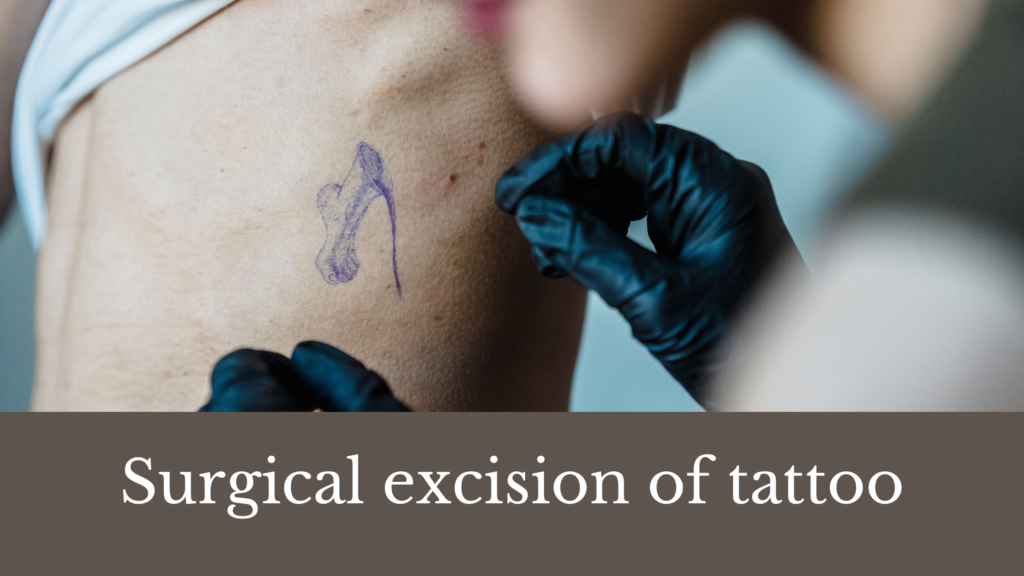
The resulting incision must heal, and the healing process creates a scar. In some patients, there may also be changes in skin color or texture.
Therefore, complete removal of the tattoo does not mean complete restoration of the original skin.
The Difference Between Removing Ink and Achieving an Invisible Result
There is an important difference between removing the tattoo and achieving an invisible tattoo removal result.
Surgical excision focuses on physically removing tattoo-bearing skin. The tattoo itself may therefore be absent from the excised area. However, the resulting scar may remain visible.
This differs from the goal many patients have when they say they want their tattoo “completely removed.” They may actually mean that they want no visible evidence that a tattoo was ever present.
That outcome cannot be guaranteed with surgical excision.
The American Society of Plastic Surgeons notes that tattoo-removal outcomes can vary and that potential risks include unfavorable scarring and permanent skin discoloration. Mayo Clinic also emphasizes that tattoo removal may not result in completely clear skin and that changes in skin color and scarring can occur with tattoo-removal treatments.
Why the Resulting Scar Becomes Part of the Final Appearance
A surgical tattoo removal scar is an inherent part of excision. Once tattooed skin is removed, the body must repair the surgical wound. Even when the incision heals well, a scar generally remains.
Scar appearance can vary according to:
- Tattoo size and shape
- Location of the tattoo
- Skin elasticity and wound tension
- Surgical technique
- Individual healing characteristics
- Previous history of hypertrophic scars or keloids
- Postoperative wound care
- Natural scar maturation over time
The scar may initially appear red, firm, raised, or more noticeable before gradually changing as it matures.
This creates the central trade-off of surgical tattoo removal: the tattoo-bearing skin can be removed, but a surgical scar takes its place.
For some patients, a linear surgical scar may be preferable to the original tattoo. For others, particularly those concerned about visible scarring, laser tattoo removal or another nonsurgical approach may be worth considering.
Key takeaway: Surgical excision can physically remove tattoo-bearing skin and may achieve very effective removal of the tattoo itself in appropriately selected cases. However, complete tattoo removal is not the same as returning the skin to its original appearance. A surgical scar, and sometimes changes in pigmentation or texture, can remain. A qualified surgeon should explain the expected scar and realistic cosmetic outcome before you choose tattoo excision.
How Much Does Surgical Tattoo Excision Cost?
The cost of surgical tattoo excision varies from patient to patient, and there is no universal price for tattoo removal surgery. Unlike some laser tattoo-removal treatments that are commonly priced by session, the cost of surgical tattoo excision depends heavily on the complexity of removing the tattoo and safely managing the resulting wound.
A small tattoo that can be removed with a straightforward excision and primary closure may have a very different cost from a larger tattoo requiring multiple procedures, skin grafting, flap reconstruction, or specialized postoperative care.
For an accurate surgical tattoo removal cost, a consultation with a qualified surgeon is usually necessary. The surgeon can assess the tattoo, surrounding skin, surgical approach, and expected number of procedures before providing an individualized estimate.
Factors That Influence Cost
Several factors can affect the cost of tattoo excision surgery, including the tattoo’s size, location, shape, surgical technique, number of procedures, and whether reconstruction is required.
The total price may also include professional fees, facility charges, anesthesia, postoperative appointments, medications, dressings, and other medical expenses. These costs can vary substantially by surgeon, geographic location, facility, and healthcare system.
Tattoo Size and Complexity
Tattoo size is one of the factors that can influence surgical tattoo removal cost, but it is not the only consideration.
A small, uncomplicated tattoo may be removed through a relatively straightforward excision. A larger or unusually shaped tattoo can require a longer procedure, more complex wound closure, or multiple treatment stages.
Tattoo location also matters. A tattoo in an area with limited skin flexibility may be more challenging to remove and close than a similarly sized tattoo in an area with greater skin laxity.
Surgical Technique
The tattoo excision technique used can have a significant effect on the overall cost.
Depending on the tattoo and the resulting wound, treatment may involve:
- Simple excision with primary closure
- Punch excision for selected very small tattoos
- Serial or staged excision
- Skin grafting
- Local flap reconstruction
- Tissue expansion in selected complex cases
- Other wound-management techniques
A straightforward excision generally requires fewer resources than a procedure involving reconstruction or specialized surgical planning.
Whether Staged Procedures Are Required
Some larger tattoos cannot be safely removed in one operation. Staged tattoo excision allows the surgeon to remove portions of the tattoo over multiple procedures, giving the surrounding skin time to adapt between stages.
If multiple surgeries are necessary, the overall cost of surgical tattoo removal will generally be higher than the cost of a single procedure because each stage may involve additional surgical, facility, anesthesia, and follow-up expenses.
However, staging may be recommended because it allows the surgeon to manage wound tension and closure more safely rather than attempting an overly large excision at once.
Grafts, Flaps or Reconstruction
If the wound cannot be closed directly after removing the tattoo, reconstructive tattoo excision may require additional techniques.
A skin graft uses skin taken from another area of the body to cover the surgical defect. A local flap uses nearby tissue that is moved into the defect while maintaining its blood supply. More complex cases may require other reconstructive approaches.
These techniques can increase the overall cost because they may require additional operating time, surgical expertise, facility resources, and postoperative care.
Surgeon, Facility and Anesthesia Fees
The total tattoo removal surgery price may consist of several separate components rather than one single surgical fee.
Depending on the practice and healthcare system, these may include:
- Surgeon or specialist fee
- Surgical facility or operating-room fee
- Anesthesia fee, when applicable
- Preoperative consultation
- Follow-up appointments
- Dressings and wound-care supplies
- Medications
- Pathology or laboratory fees when indicated
- Additional treatment for complications, if required
The type of anesthesia depends on the procedure. Some smaller excisions may be performed using local anesthesia, while more extensive procedures may require a different anesthesia plan.
Why Online Prices May Not Represent Your Final Cost
Searching for “surgical tattoo removal cost near me” or “tattoo excision price” can provide a general idea of what providers advertise, but online prices should not be treated as a personalized quote.
Two tattoos of the same size can require very different surgical approaches because of differences in location, shape, skin laxity, wound tension, and previous treatment.
A clinic advertising a starting price may also exclude expenses such as anesthesia, facility fees, follow-up care, or additional surgical stages. Before proceeding, ask the provider what is included in the quoted price and whether additional procedures could change the total cost.
For patients comparing surgical tattoo excision vs. laser tattoo removal cost, it is also important to compare the complete treatment pathway rather than looking only at the price of one session. Laser treatment may require multiple sessions, while surgical excision may involve one procedure or several staged procedures depending on the tattoo.
Key takeaway: There is no fixed price for surgical tattoo excision. The final cost depends on tattoo size and complexity, location, surgical technique, whether staged excision is needed, reconstruction requirements, surgeon and facility fees, and anesthesia. A personalized consultation is the most reliable way to determine the expected cost and understand exactly what is included in the treatment estimate.
How to Choose a Qualified Practitioner for Tattoo Excision
Choosing the right practitioner is an important part of planning surgical tattoo removal. Tattoo excision is a surgical procedure that removes tattoo-bearing skin and creates a wound that must be closed or otherwise managed. The quality of the surgical plan, wound closure, and scar management can all influence the final result.
When researching tattoo excision surgeons, look for an appropriately qualified medical professional with relevant surgical training, experience with skin excision and wound closure, and access to a suitable accredited or appropriately regulated surgical facility.
The American Society of Plastic Surgeons (ASPS) recommends choosing an appropriately qualified, board-certified plastic surgeon and emphasizes checking credentials, experience, and the safety standards of the surgical facility.
Relevant Surgical Qualifications
The first step is verifying that the practitioner has appropriate surgical qualifications and credentials for the procedure being offered.
Depending on your country, the terminology for specialist qualifications and board certification varies. In the United States, for example, patients can verify whether a plastic surgeon is board certified through the relevant professional and certification organizations.
Do not rely solely on titles used in advertising. Ask which medical board or professional organization issued the practitioner’s certification and whether the surgeon’s credentials are current.
It is also reasonable to ask where the procedure will be performed and whether the facility meets applicable safety and accreditation standards.
Experience With Tattoo Excision
General surgical experience is valuable, but experience with tattoo excision can be particularly relevant because tattoo removal surgery has its own considerations.
Ask how frequently the surgeon performs surgical tattoo removal and whether they regularly treat tattoos of a similar size and location to yours.
A surgeon experienced in tattoo excision should be able to explain why a particular approach is appropriate for your tattoo and discuss alternatives when simple excision is not practical.
Depending on the case, these may include:
- Simple excision and primary closure
- Punch excision for selected small tattoos
- Serial or staged excision
- Skin grafting
- Local flap reconstruction
- Other reconstructive techniques
The goal is not simply to find someone who can remove the tattoo. It is to find a qualified surgeon who can plan the procedure around safe wound closure and the expected scar.
Experience With Wound Closure and Scar Management
Because surgical tattoo removal creates a wound, experience with wound closure and scar management is an important consideration.
Ask the practitioner how they expect to close the wound after removing your tattoo and what type of scar you should realistically expect.
A qualified surgeon should be able to explain factors such as:
- Expected incision length
- Wound tension
- Suture technique
- Whether staged excision may be necessary
- Potential need for grafting or flap reconstruction
- Expected recovery time
- Scar maturation
- Options for managing a problematic scar
This discussion is particularly important for patients with a history of hypertrophic scars or keloids.
Questions to Ask During Consultation
A tattoo excision consultation should give you an opportunity to understand the procedure, risks, expected results, recovery, and cost.
Consider asking:
- Am I a good candidate for surgical tattoo excision?
- How much of my tattoo can realistically be removed?
- What type of excision would you recommend and why?
- Can the wound be closed directly, or might I need staged excision, a graft, or a flap?
- Where will the surgical scar be located, and approximately how long could it be?
- What complications are possible with this procedure?
- How long should I expect recovery to take?
- What restrictions will I have after surgery?
- How will the incision and resulting scar be managed?
- What happens if the wound heals poorly or the scar becomes problematic?
- How many procedures might I need?
- What is included in the total treatment cost?
- Where will the procedure be performed?
- What type of anesthesia will be used?
- What are my alternatives to surgical excision?
Be cautious if a practitioner promises “scarless tattoo removal,” “guaranteed complete removal,” or an identical result to your original skin. Surgical excision necessarily involves an incision and therefore carries the possibility of a permanent scar.
What Information to Bring to the Consultation
Providing a complete treatment history can help the surgeon make a more informed assessment.
Bring details about:
- When the tattoo was created
- The approximate size and age of the tattoo
- Any previous laser tattoo-removal sessions
- Other tattoo-removal treatments you have tried
- Any previous complications from tattoo treatment
- Your history of prominent scars or keloids
- Current medications and relevant medical information
- Previous surgeries involving the same area
- Your main goal and expectations for tattoo removal
If the tattoo has already undergone laser treatment, tell the surgeon which type of laser treatment you received, approximately how many sessions you had, and when the most recent session occurred, if you know.
Photographs showing the tattoo before previous treatment can also be useful when assessing how much pigment has already been removed.
Key takeaway: Choosing a qualified practitioner for tattoo excision involves more than finding the lowest price or the first clinic that offers the procedure. Look for appropriate surgical qualifications, relevant experience with tattoo excision, expertise in wound closure and scar management, and a suitable surgical facility. A thorough consultation should explain the expected tattoo-removal result, permanent scar, risks, recovery, alternatives, and total cost before you make a decision.
Questions to Ask Before Agreeing to Tattoo Excision
Before agreeing to surgical tattoo excision, it is important to understand how the procedure will be performed, what results are realistic, how much scarring to expect, and what recovery will involve. Tattoo excision physically removes tattooed skin, so the decision should consider both the potential benefit of removing the tattoo and the permanent scar that may result.
A detailed consultation with a qualified surgeon can help you compare tattoo excision vs. laser tattoo removal and determine which option is more appropriate for your tattoo, skin, and expectations.
What Technique Would You Use for My Tattoo?
Ask the surgeon which tattoo excision technique they recommend and why it is appropriate for your tattoo.
Depending on the tattoo’s size, shape, location, and surrounding skin, options may include simple excision with primary closure, punch excision, serial or staged excision, skin grafting, or local flap reconstruction.
Understanding the recommended technique can help you determine whether the proposed approach is designed around safe wound closure rather than simply removing as much tattooed skin as possible.
How Large Will the Resulting Scar Be?
One of the most important questions before surgical tattoo removal is how the resulting scar is expected to look.
Ask:
- Where will the scar be located?
- Approximately how long might the incision be?
- Will the scar be straight or have another shape?
- Could the scar become wider or more noticeable during healing?
- How will the scar be managed after surgery?
The scar may be longer than the original tattoo in some cases because the surgeon must design an incision that allows the wound to be safely closed. Scar appearance can also change as it matures.
Could I Need More Than One Procedure?
Ask whether your tattoo can realistically be removed in one operation or whether staged tattoo excision may be necessary.
Larger tattoos, tattoos in areas with limited skin laxity, or tattoos where direct closure would create excessive tension may require multiple procedures.
If more than one procedure could be necessary, ask the surgeon to explain:
- Why staging may be recommended
- How much tattoo may be removed during each stage
- How long you may need to wait between procedures
- What the overall recovery could involve
- How additional procedures could affect the total cost
Knowing this before surgery can help you develop realistic expectations about the treatment timeline.
Would Laser Be a Better Option?
Ask whether laser tattoo removal could provide a better balance between tattoo fading, scarring, treatment time, and cost.
Laser treatment and surgical excision work differently. Laser tattoo removal targets tattoo pigment within the skin, while excision removes the tattoo-bearing skin.
Laser treatment may require multiple sessions and may not completely remove every tattoo. Surgical excision can physically remove tattooed skin but creates a surgical scar.
The best option depends on factors such as tattoo size, ink colors, location, previous treatment, skin characteristics, and your priorities.
How Will the Wound Be Closed?
Ask how the surgeon plans to manage the wound after removing the tattoo.
For a suitable small tattoo, the wound may be closed directly with sutures. More extensive defects may require staged excision, skin grafting, local flap reconstruction, or another wound-management technique.
Understanding the planned closure can help you understand both the expected scar and the likely recovery process.
What Complications Should I Watch For?
Ask the surgeon to explain the potential tattoo excision risks and complications before agreeing to treatment.
Potential complications can include:
- Infection
- Poor wound healing
- Wound separation
- Excessive or unfavorable scarring
- Hypertrophic scars
- Keloid formation
- Skin-color changes
- Persistent pain or sensitivity
- Unsatisfactory cosmetic results
Also ask which symptoms are expected during normal recovery and which ones should prompt you to contact the surgical team.
What Will Recovery Involve?
Ask for a realistic tattoo excision recovery timeline rather than relying on a generic number of days.
Your surgeon should explain:
- How the wound will be cared for
- Whether you will need dressings
- When sutures may be removed, if applicable
- When you can shower normally
- When you can return to work
- When exercise can resume
- When swimming or other activities are permitted
- How follow-up appointments will work
- When scar care can begin
Recovery can vary considerably depending on the size and location of the excision and whether reconstruction is required.
What Will Happen If the Scar Heals Poorly?
Ask what options are available if the tattoo excision scar becomes raised, widened, painful, unusually dark, or otherwise problematic.
Depending on the type of scar and the circumstances, treatment may involve conservative scar care, injections, laser-based treatments, or surgical scar revision. Keloids can be particularly challenging because they may recur after treatment.
It is also worth asking whether scar treatment is included in the original treatment plan or would involve additional costs.
Key takeaway: Before agreeing to tattoo excision, ask about the surgical technique, expected scar size, number of procedures, laser alternatives, wound closure, potential complications, recovery, and scar-management options. A good consultation should give you enough information to understand both the potential benefits and the permanent trade-offs of surgical tattoo removal before you proceed.
Frequently Asked Questions
If you are considering surgical tattoo removal, you may have questions about how tattoo excision works, whether your tattoo is suitable for surgery, what recovery involves, and whether the procedure can completely remove the tattoo. The answers below provide general information, but a qualified surgeon should assess your individual tattoo before treatment.
What Is Surgical Excision of Tattoo?
Surgical excision of tattoo is a procedure in which the surgeon removes the section of skin containing the tattoo. The remaining skin may then be brought together and closed with sutures.
For selected small tattoos, simple excision and primary closure may be possible. Larger or more complex tattoos may require staged excision, skin grafting, flap reconstruction, or another wound-management technique.
Can Any Tattoo Be Surgically Removed?
No. Not every tattoo is suitable for surgical excision.
A surgeon considers the tattoo’s size, shape, location, skin elasticity, available skin, wound tension, and the expected scar. A small tattoo in an area with sufficient skin laxity may be easier to remove surgically than a similarly sized tattoo located on tight or highly mobile skin.
Large tattoos may sometimes be treated with staged excision or reconstructive techniques, but surgery may not be the most appropriate option for every patient.
Does Surgical Tattoo Removal Leave a Scar?
Yes. Surgical tattoo excision leaves a scar because the tattooed skin is physically removed and the resulting wound must heal.
The scar’s appearance depends on factors such as tattoo size, location, surgical technique, wound tension, individual healing, and a person’s tendency to develop hypertrophic scars or keloids.
This is one of the most important differences between surgical excision and laser tattoo removal: excision can remove tattoo-bearing skin, but it creates a surgical scar that becomes part of the final appearance.
Is Surgical Tattoo Removal Painful?
Tattoo excision is performed with anesthesia, so sharp pain during the procedure is generally minimized. For many smaller procedures, local anesthesia may be used to numb the treatment area.
You may still feel pressure, pulling, or movement during surgery. Once the anesthetic wears off, some soreness, tenderness, swelling, or sensitivity can occur.
The amount of postoperative discomfort depends on the size and location of the excision, the surgical technique, and individual pain sensitivity. Your surgeon will provide specific instructions for managing discomfort after the procedure.
How Long Does Tattoo Excision Take to Heal?
Tattoo excision recovery time varies depending on the size and location of the wound, how it was closed, and individual healing.
The incision begins healing immediately after surgery, but complete scar maturation takes much longer. A scar may initially appear red, firm, raised, or noticeable before gradually changing over the following months.
Your surgeon can provide a more specific recovery timeline based on your procedure and explain when you can return to work, exercise, swimming, and other normal activities.
Can Large Tattoos Be Removed Surgically?
Large tattoos can sometimes be removed surgically, but they may require a more complex treatment plan than small tattoos.
If removing the entire tattoo at once would create a wound that cannot be safely closed, a surgeon may recommend serial or staged tattoo excision. This involves removing sections during separate procedures and allowing the surrounding skin to adapt between stages.
Depending on the resulting defect, reconstructive techniques such as skin grafting or local flap reconstruction may also be considered.
Is Surgical Excision Better Than Laser Removal?
Neither treatment is universally better. Surgical tattoo excision and laser tattoo removal have different advantages and limitations.
Surgical excision physically removes tattoo-bearing skin and can therefore provide substantial removal of the tattooed area in appropriately selected cases. However, it creates a surgical scar.
Laser tattoo removal targets tattoo pigment without surgically removing the skin, but it commonly requires multiple treatment sessions and may not completely eliminate the tattoo.
The better option depends on the tattoo’s size, color, location, skin characteristics, previous treatment, desired outcome, tolerance for scarring, treatment timeline, and cost.
How Much Does Tattoo Excision Cost?
There is no universal tattoo excision cost. The price depends on factors such as:
- Tattoo size and complexity
- Body location
- Surgical technique
- Number of procedures required
- Whether staged excision is necessary
- Need for skin grafts or flap reconstruction
- Surgeon fees
- Facility fees
- Anesthesia
- Follow-up and postoperative care
An online advertised price may represent only a starting price and may not include every component of treatment. A consultation is generally necessary to receive an individualized estimate.
Can a Tattoo Be Surgically Removed After Laser Treatment?
Yes. Surgical tattoo excision after laser treatment may be possible in selected cases.
Some tattoos retain visible pigment after multiple laser sessions. If a relatively small amount of residual tattoo remains and the area is suitable for excision, a surgeon may consider removing the remaining tattoo-bearing skin.
Previous laser treatment can affect surgical planning, so the surgeon should evaluate the skin’s condition, previous treatment history, scarring, pigmentation changes, and the expected surgical scar before recommending excision.
Can Tattoo Excision Completely Remove Tattoo Ink?
Tattoo excision can physically remove the tattoo-bearing skin, which is different from simply fading the ink.
However, complete removal of the tattoo does not necessarily mean the skin will return to its original appearance. A surgical scar generally remains, and some patients may experience changes in skin color or texture.
Therefore, there is an important distinction between removing the tattoo itself and achieving completely invisible skin. Surgical excision may remove the visible tattoo from the excised tissue, but it cannot guarantee that there will be no visible evidence of treatment.
Key takeaway: Surgical tattoo excision can be an effective option for carefully selected tattoos, particularly when removing a localized area of tattooed skin is technically practical. However, it is still surgery and carries risks, recovery requirements, and the likelihood of a permanent scar. A qualified practitioner should evaluate your tattoo and explain whether excision, laser treatment, staged surgery, or another approach is most appropriate for your individual goals.
Surgical Excision of Tattoo: Procedure, Scarring, Recovery, Cost & Alternatives
Surgical excision of tattoo is a form of tattoo removal in which a surgeon physically removes the skin containing tattoo pigment. Unlike laser tattoo removal, which breaks tattoo ink into smaller particles that the body can gradually clear, surgical excision removes the tattoo-bearing tissue itself.
For selected tattoos, particularly smaller tattoos with enough surrounding skin for safe closure, excision can be an effective way to remove tattooed skin. However, it is important to understand the trade-off: surgical tattoo removal creates a wound and therefore a permanent scar is expected.
Whether tattoo excision is appropriate depends on much more than tattoo size. A qualified surgeon will consider the tattoo’s location, shape, skin elasticity, available skin, wound tension, previous treatments, expected scar, and overall health before recommending surgery.
What Is Surgical Excision of Tattoo?
Tattoo excision surgery involves removing the portion of skin that contains the tattoo. After the tattooed tissue is removed, the surgeon manages the resulting wound using the most appropriate closure or reconstruction technique.
For a small tattoo, the surgeon may be able to remove the tattooed skin and close the wound directly with sutures. Larger or more complex tattoos may require serial excision, skin grafting, local flap reconstruction, or other surgical techniques.
The objective is not simply to remove the maximum amount of tattooed skin. The surgeon must also consider whether the remaining skin can be closed safely and what type of scar is likely to result.
Does Tattoo Size Determine Whether Excision Is Possible?
Tattoo size is an important factor, but there is no universal size limit for surgical tattoo removal.
Small tattoos are often easier to remove because the resulting wound may be small enough for direct closure. However, a small tattoo located on tight or highly mobile skin can be more challenging than a larger tattoo in an area with greater skin laxity.
Large tattoos may sometimes be treated through staged or serial excision, allowing the surgeon to remove sections over multiple procedures.
The tattoo’s shape, location, skin elasticity, and available surrounding tissue can therefore be just as important as its dimensions.
Does Tattoo Location Affect Surgical Excision?
Yes. Tattoo location can significantly influence the feasibility of surgical excision and the expected scar.
Areas with greater skin laxity may provide more tissue for wound closure, while areas with tight skin can create greater tension after an excision. Tattoos near joints may require additional planning because movement can stress the healing incision.
The hands, feet, lower legs, face, and other cosmetically sensitive areas can also present unique challenges. A tattoo of the same size can have very different surgical options depending on where it is located.
This is why a surgeon evaluates the tattoo and surrounding skin as a complete anatomical area, rather than judging suitability from tattoo size alone.
What Surgical Techniques Can Be Used for Tattoo Excision?
The appropriate tattoo excision technique depends on the tattoo’s characteristics and the resulting surgical defect.
Simple Excision and Primary Closure
The tattooed skin is removed and the surrounding skin is brought together and closed, commonly with sutures. This is generally most suitable for selected smaller tattoos.
Punch Excision
A punch instrument can remove a small circular section of tattooed skin. This approach may be considered for very small tattoos or isolated tattooed areas.
Serial or Staged Excision
Staged tattoo excision involves removing the tattoo in sections over multiple procedures. This can allow surrounding skin to adapt between operations and may make closure more manageable for larger tattoos.
Skin Grafting
If the wound cannot be closed directly, a skin graft may be used to cover the defect. Skin is taken from another part of the body and placed over the surgical wound.
Local Flap Reconstruction
A local flap uses nearby tissue that remains connected to its blood supply and is moved to cover the defect. This may be considered when direct closure is not practical.
Tissue Expansion
In selected complex cases, tissue expansion can gradually increase the amount of available skin before reconstruction.
Healing by Secondary Intention
Some wounds may be allowed to heal naturally without immediate surgical closure. Whether this is appropriate depends heavily on the wound’s size, depth, location, and expected cosmetic result.
Does Surgical Tattoo Removal Hurt?
Tattoo excision is performed using anesthesia to minimize pain during the procedure. Smaller procedures may often be performed using local anesthesia, while the appropriate anesthesia plan for more extensive surgery depends on the procedure and patient.
After the anesthetic wears off, some soreness, tenderness, swelling, or sensitivity may occur. Discomfort can vary according to tattoo size, location, surgical technique, wound size, and individual pain tolerance.
Your surgeon should provide personalized instructions for managing postoperative discomfort.
Will Surgical Excision Leave a Scar?
Yes. A scar is an inherent part of surgical tattoo excision.
Because the procedure removes skin, the resulting wound must heal. Even when healing progresses normally, a surgical scar generally remains.
Scar appearance can be influenced by:
- Tattoo size and shape
- Body location
- Incision design
- Wound tension
- Surgical technique
- Individual healing
- Previous hypertrophic scars or keloids
- Postoperative wound care
A scar may initially be red, firm, raised, or more noticeable and can gradually change as it matures.
This creates an important distinction between tattoo removal and skin restoration. Excision may remove the tattoo-bearing skin, but it does not guarantee that the area will look exactly as it did before the tattoo.
What Is Recovery Like After Tattoo Excision?
Tattoo excision recovery varies according to the size and location of the wound, closure technique, and individual healing.
During the first 24–48 hours, the priority is generally protecting the surgical site and following the surgeon’s wound-care instructions. Some tenderness, swelling, or bruising may occur.
During the first week, the incision continues through the early stages of healing. Follow-up may be required to evaluate the wound and manage sutures if necessary.
Normal activities and exercise may need to be restricted temporarily, particularly if movement, friction, stretching, or heavy lifting could place tension on the incision.
Although the wound may heal relatively quickly, scar maturation takes considerably longer and can continue for many months.
Tattoo Excision Aftercare: What Should You Do?
Good tattoo excision aftercare helps protect the surgical wound while it heals.
Your surgeon may provide instructions regarding:
- Keeping the surgical site clean
- Changing or maintaining dressings
- Taking medications as prescribed
- Protecting the wound from friction
- Avoiding unnecessary tension
- Limiting exercise temporarily
- Protecting the healing scar from excessive sun exposure
- Attending follow-up appointments
Always prioritize your surgeon’s specific postoperative instructions over general online advice because wound-care requirements vary according to the procedure and closure method.
What Are the Risks and Possible Complications?
Like other surgical procedures, tattoo excision carries potential risks.
Possible complications include:
- Infection
- Poor wound healing
- Wound separation
- Hypertrophic scarring
- Keloid formation
- Skin-color changes
- Unfavorable scarring
- Unsatisfactory cosmetic results
- Need for additional surgery
The American Society of Plastic Surgeons identifies risks including infection, poor wound healing, permanent skin discoloration, unfavorable scarring, and possible further surgery among potential tattoo-removal complications.
Your individual risk depends on factors such as the surgical technique, tattoo location, wound size, healing characteristics, and medical history.
What If the Tattoo Has Already Been Treated With Laser?
Surgical excision may still be possible after laser tattoo removal in selected cases.
Laser treatment can significantly fade a tattoo without necessarily eliminating all visible pigment. If residual pigment remains and the tattoo is suitable for surgical removal, excision may be considered.
Previous laser treatment is important information for the surgeon because the skin may have experienced changes in pigmentation, texture, or scarring. A medical assessment can determine whether the skin is suitable for another intervention and whether excision offers a reasonable benefit.
The two treatments work differently: laser treatment targets pigment within the skin, while surgical excision removes the tattoo-bearing skin.
Can Surgical Excision Completely Remove a Tattoo?
Surgical excision can physically remove tattoo-bearing skin, but complete removal of the tattoo does not mean the skin will return to its original appearance.
The tattoo pigment contained within the removed tissue can be eliminated from that section of skin. However, a surgical scar generally remains, and some patients can experience changes in skin color or texture.
This distinction is important when setting expectations. The goal may be to replace a visible tattoo with a less noticeable surgical scar rather than to produce completely invisible, untreated skin.
The American Society of Plastic Surgeons and Mayo Clinic both emphasize realistic expectations regarding tattoo-removal outcomes, including the possibility of scarring and skin-color changes.
How Much Does Surgical Tattoo Excision Cost?
There is no fixed surgical tattoo removal cost because treatment requirements vary considerably.
Factors that can influence the total price include:
- Tattoo size and complexity
- Tattoo location
- Surgical technique
- Number of procedures
- Staged excision
- Skin grafting or flap reconstruction
- Surgeon fees
- Facility fees
- Anesthesia
- Follow-up care
An advertised online price may represent only a starting price and may not include every component of treatment.
For an accurate tattoo excision cost, a consultation is generally required so the surgeon can assess the tattoo and provide an individualized treatment plan and estimate.
How to Choose a Qualified Practitioner for Tattoo Excision
Choosing an appropriately qualified practitioner is an important part of surgical tattoo removal.
Look for a surgeon with appropriate surgical credentials and experience in skin excision, wound closure, reconstruction, and scar management. Experience specifically with tattoo excision can also be valuable because the procedure requires balancing tattoo removal with safe closure and cosmetic considerations.
The American Society of Plastic Surgeons recommends choosing an appropriately qualified, board-certified plastic surgeon and evaluating the surgeon’s credentials and surgical facility.
During a consultation, ask about the recommended technique, expected scar, number of procedures, recovery, risks, alternatives, and total cost.
Questions to Ask Before Agreeing to Tattoo Excision
Before undergoing tattoo excision surgery, consider asking:
- What technique would you recommend for my tattoo?
- How large is the expected surgical scar?
- Can the tattoo be removed in one procedure?
- Could I need staged excision?
- Would laser tattoo removal be a better option?
- How will the wound be closed?
- What complications should I watch for?
- How long will recovery take?
- When can I return to work and exercise?
- How will the scar be managed?
- What happens if the scar heals poorly?
- What is included in the total treatment cost?
These questions can help you understand both the potential benefits and limitations before making a decision.
Frequently Asked Questions
What Is Surgical Excision of Tattoo?
Surgical tattoo excision is a procedure in which tattoo-bearing skin is physically removed. The resulting wound is then closed or managed using an appropriate surgical or reconstructive technique.
Can Any Tattoo Be Surgically Removed?
No. Suitability depends on tattoo size, shape, location, skin elasticity, available skin, wound tension, and the expected scar. Some larger tattoos may require staged procedures or reconstruction.
Does Surgical Tattoo Removal Leave a Scar?
Yes. Because tattoo excision removes skin and creates a surgical wound, a permanent scar is generally expected.
Is Surgical Tattoo Removal Painful?
Anesthesia helps minimize pain during surgery. Some soreness and tenderness can occur after the anesthetic wears off, with discomfort varying according to the procedure and individual healing.
How Long Does Tattoo Excision Take to Heal?
The initial wound may heal over weeks, but the resulting scar can continue changing and maturing for many months. Your surgeon can provide a personalized recovery timeline.
Can Large Tattoos Be Removed Surgically?
Some large tattoos can be treated surgically, often using staged or serial excision. Skin grafts, local flaps, or other reconstructive techniques may be considered for selected complex cases.
Is Surgical Excision Better Than Laser Removal?
Neither approach is universally better. Excision removes tattoo-bearing skin but creates a scar, while laser treatment targets pigment and often requires multiple sessions. The appropriate option depends on the tattoo and the patient’s goals.
How Much Does Tattoo Excision Cost?
The price varies according to tattoo size, location, surgical technique, number of procedures, reconstruction, surgeon fees, facility costs, and anesthesia. A consultation is needed for an individualized estimate.
Can a Tattoo Be Surgically Removed After Laser Treatment?
Yes, selected tattoos can potentially undergo surgical excision after laser treatment. The surgeon should evaluate the treated skin and previous treatment history before recommending another procedure.
Can Tattoo Excision Completely Remove Tattoo Ink?
Excision can remove the tattoo-bearing skin itself, but it does not guarantee completely invisible skin afterward. A surgical scar and possible pigment or texture changes may remain.
Final Takeaway
Surgical excision of tattoo can provide a direct way to remove tattoo-bearing skin, but it is not simply a larger version of laser tattoo removal. It is a surgical procedure with its own considerations for scarring, wound healing, recovery, cost, and potential complications.
The most appropriate treatment depends on the individual tattoo—not just its size. Location, shape, skin laxity, previous laser treatment, expected scar, and the availability of surrounding skin all influence whether excision is practical.
If you are considering tattoo excision near you, start by consulting an appropriately qualified practitioner who can examine the tattoo in person and explain whether surgical excision, laser tattoo removal, staged surgery, or another approach is most suitable for your goals.